
Vishwas Nangre Patil Indian Police Service

Home / Journey

02 — The Journey

A journey of responsibility.

Twelve commands across twenty-nine years, in one state cadre. Read as a pathway rather than a list: each stage carries the post, the place, what the charge actually required, and what is documented about it.

Vishwas Nangre Patil standing with arms folded in front of the Maharashtra Police emblem
Maharashtra Police — the single cadre in which the whole of this career has been served

An IPS officer's career is a sequence of charges handed over on a fixed date, in a fixed place, with a fixed scope. It is unusually well documented for that reason: transfer orders are published, charges are handed over in front of cameras, and the posting itself is a matter of public record.

What is not always documented is the individual contribution inside a charge, because policing outcomes belong to organisations. Where this page can point to something specific and published, it does. Where it cannot, it describes the responsibility and stops there.

1997Entry to service

Indian Police Service, 1997 batch

Maharashtra cadre

Selection through the Union Public Service Commission's civil services examination, followed by probation and allotment to the Maharashtra cadre — the state in which every subsequent posting on this page has been served.
Late 1990sFirst field charge

Assistant Superintendent of Police

Dhule, north-west Maharashtra

The first substantive charge for an IPS officer: a subdivision of a district, with its police stations reporting through him. It is where the profession is learned in practice rather than at the academy — investigation supervision, station inspection, and the first experience of holding law and order in a defined territory.

c. 2000Second charge

Additional Superintendent of Police

Nanded, Marathwada

Second-in-command of a district force in the Marathwada region. The Additional SP typically carries the operational load of a district — supervision of serious investigations, deployment during festivals and elections, and command of the district's reserve force — while the Superintendent holds overall charge.

2002 – 2004First independent district

Superintendent of Police, Latur

Latur district, Marathwada

His first independent command of a whole district: every police station in Latur, the district's crime and law-and-order picture, its investigations, and its personnel. For an officer roughly five years into service, a district SP's charge is the first time the buck genuinely stops with them.

2008Metropolitan command

Deputy Commissioner of Police, Zone 1

South Mumbai, Mumbai Police

Zone 1 covers the southern tip of Mumbai: the port, the business district, the government precinct and the hotels of Colaba and Apollo Bunder. A Mumbai DCP commands several police stations directly and is the first senior officer on the ground when something happens inside the zone.

On the night of 26 November 2008, the coordinated attacks on Mumbai included the Taj Mahal Palace Hotel, inside this zone.

Documented contribution

He was among the first police officers to reach the hotel and entered the building without body armour with the small force available at that hour, holding the attackers away from the areas where several hundred guests were gathered and assisting the evacuation before specialist units arrived. In 2015 he was awarded the President's Police Medal for Gallantry for his part in the counter-terrorist operations of those days.

2010 – 2011District command

Superintendent of Police, Thane Rural

Thane district, Konkan

Thane Rural is one of the more demanding district charges in the state: a very large jurisdiction wrapped around the edge of the Mumbai metropolitan region, mixing dense peri-urban settlement, industrial belts, highways and genuinely rural blocks within a single command.

MumbaiRegional command

Additional Commissioner of Police, West Region

Mumbai Police

A step above the zone: an Additional Commissioner in Mumbai supervises several zones together as a region, taking responsibility for coordination across a large slice of the city rather than for a single set of police stations.

Published sources record the posting without fixing its dates, so no dates are asserted here.

2015 – 2016Range command

Special Inspector General of Police, Aurangabad Range

Marathwada

A range is a group of districts. The officer commanding it does not run any single district force but supervises several district Superintendents together — a supervisory and inspecting charge rather than a directly operational one, and the first rung of genuinely senior police administration.

c. 2016 – 2019Range command

Special Inspector General of Police, Kolhapur Range

Kolhapur, Sangli, Satara, Solapur, Pune Rural

The Kolhapur range covers western Maharashtra — including Sangli district, where he was born. He held the range until his transfer to Nashik in 2019.

2019 – 2020City commissionerate

Commissioner of Police, Nashik City

Nashik, north Maharashtra

His first commissionerate: a self-contained city police force with its own commissioner rather than a district under a Superintendent. Nashik is one of Maharashtra's larger cities and a major pilgrimage centre, which puts crowd management and public order permanently on the commissioner's desk.

He was appointed in 2019 and moved to Mumbai in September 2020.

2020 – 2022State capital, law and order

Joint Commissioner of Police (Law & Order), Mumbai

Mumbai Police

From 4 September 2020 to 15 December 2022. Law and Order is the single largest portfolio in the Mumbai Police after the Commissioner: the whole city's public order, protest and procession management, force deployment and preventive action, held by one officer.

The tenure covered the pandemic period and its restrictions, when the city's police were also administering an unprecedented set of public health rules.

2022 – 2026State agency command

Additional Director General of Police, Anti-Corruption Bureau

Maharashtra, state-wide

He took charge of the Maharashtra Anti-Corruption Bureau on 15 December 2022 on promotion to Additional Director General of Police. The ACB is a state-wide investigating agency rather than a territorial command: trap cases against public servants, disproportionate-assets investigations, and the prosecutions that follow.

Institutional context

During this tenure the bureau registered 713 corruption cases in 2024 — 678 traps, 31 disproportionate-assets cases and seven related offences — against 1,316 a decade earlier in 2014. These are agency figures, not personal ones, and are set out with their sources on the impact page.

The present charge

Commissioner of Police, Nagpur City.

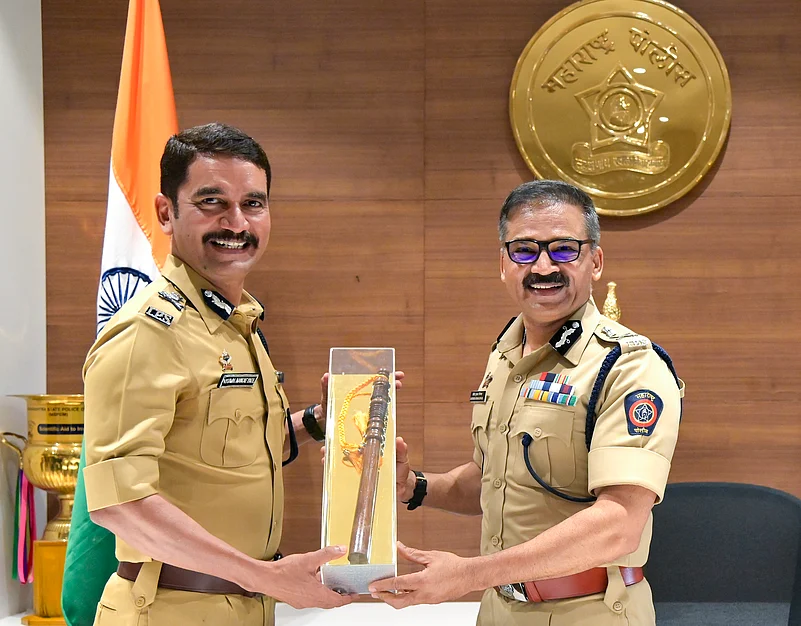
Vishwas Nangre Patil receiving a ceremonial baton from a senior police officer at a handover
Handover of charge, Nagpur City Police, June 2026

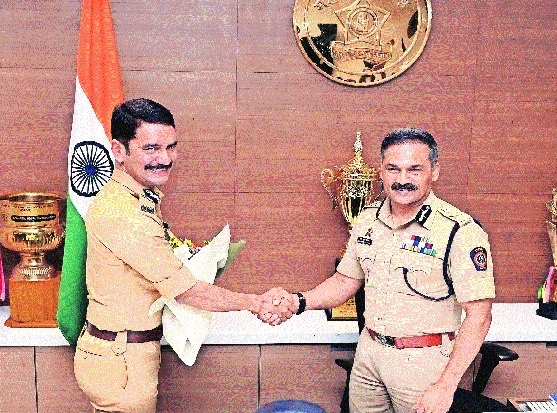
The Maharashtra Home Department issued the transfer order on 23 June 2026, moving him from the Anti-Corruption Bureau to the Nagpur commissionerate. He assumed charge on 29 June 2026, taking over from Dr Ravinder Kumar Singal, who moved in the opposite direction to the ACB.

Nagpur is the second capital of Maharashtra and the seat of the state legislature's winter session. Its commissionerate carries city law and order, crime, traffic, and the security load that comes with hosting the legislature.

In the first weeks he stated his priorities publicly: preventive and visible policing, conviction rates, the safety of women and children, drug abuse among young people, technology-led investigation, and public trust. The initiatives that followed are documented on the impact page.

“Police visibility itself acts as a deterrent to crime.” Vishwas Nangre Patil, Commissioner of Police, Nagpur City
Reported by Nagpur Today, 30 June 2026
Vishwas Nangre Patil shaking hands with the outgoing Commissioner of Police at the handover of charge
Handover of charge with the outgoing Commissioner of Police, Nagpur, June 2026

What the postings required.

The leadership page takes the same career and reads it thematically — decision, discipline, team, trust, response and accountability — using what is on the public record.