Home / Service
04 — The People
Service is where institutions meet people.
Everything else on this website is organisational. This page is about the contact surface: the counter, the chowki, the beat officer, the number you call at two in the morning — and what has been done, on the record, to change how those feel.
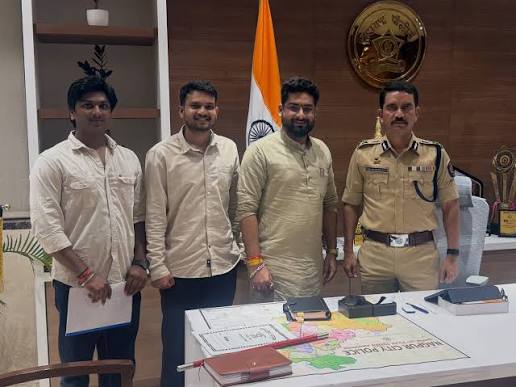
The contact surface
Most people meet the police once, badly, on the worst day of their year.
That single encounter forms almost the whole of what a citizen believes about a force of several thousand people. It usually happens at a counter, in a chowki, or on a phone line — not in any of the places where policy is made.
The measures set out below all work on that surface. They are drawn from documented announcements made in the Nagpur commissionerate between June and August 2026, and from his own published statements.
Six working themes
What public-facing policing was asked to become.
Accessibility
In August 2026 the commissionerate set out to convert police chowkis — outposts that had largely functioned as reporting points — into working mini police stations on the Mumbai model, with each police station's three or four beats served from them. Complaints, beat duty and preventive action move to the chowki instead of travelling to the main station.
Reach
Each beat officer was to be attached to a hundred-member neighbourhood group, giving residents a named officer for their own street rather than a general number. “The police must be seen on the streets,” he said in August 2026. “People must feel that the police are with them.”
Safety of women
Twenty smart police booths were to be converted into pink booths, and a Nirbhaya squad deployed for women's safety. The August 2026 action plan named crimes against women and children as one of the explicit measures of the force's performance, with enforcement under the POCSO Act for offences against children.
Responsiveness
The same plan committed the force to regular assessment of emergency response times on the 112 line, alongside night patrolling with high field presence and increased naka bandi. Thirty traffic hotspots and fifty black spots were identified for work.
Communication
Public awareness campaigns on cyber security were built into the crime plan rather than treated as outreach around it — a recognition that for online fraud the only effective policing usually happens before the money moves.
Shared responsibility
“Every responsible citizen is a police officer without a uniform,” he said on taking charge in Nagpur in June 2026. The framing runs through the rest: CCTV encouraged among residents and businesses, neighbourhood groups, and prevention treated as something a city does with its force rather than to it.
Institutional context
What “beat policing” means, and why it keeps being rediscovered.
A beat is the smallest unit of police geography: a few streets, assigned to a named constable or officer who is expected to know them. It is one of the oldest arrangements in policing and one of the first to be abandoned under pressure, because officers on a beat are the easiest people to pull away when something urgent happens somewhere else.
The recurring argument for restoring it is that almost all preventive knowledge in a police force is local and unwritten — who is out of prison, which shop is a front, which dispute is about to become a case — and that this knowledge only exists if somebody is standing in the same place often enough to acquire it.
This is general context about policing practice, offered to explain the measures above. It is not a comment by any third party on Vishwas Nangre Patil or on the Nagpur commissionerate.
A note on evidence
Announced is not the same as achieved.
Every measure on this page was announced publicly and reported at the time. None of them has yet been independently evaluated, because most were announced within the last three months. This site therefore describes them as commitments and mechanisms, with their dates, and does not present them as results.
Where a result has been published — a caseload, a figure, an outcome — it appears on the impact page with its source attached.